slideshow

Thursday, September 8, 2011

My Italian Sketchbook

Church in Pescara, watercolor
Happy PPF a bit early! I have to work early in the morning, so thought I would get this posted before I go to bed tonight. Finally photographed my sketchbook from Italy, pitiful showing for two and a half weeks, though we were busy going here and there! And I have over 3,000 photographs to work from in the future.

Most of these are from a lovely 8x10 sketch book that John gave us when we arrived at The Retreat. It took the watercolor surprisingly well, with minimal buckling.

Street in Force, watercolor & ink

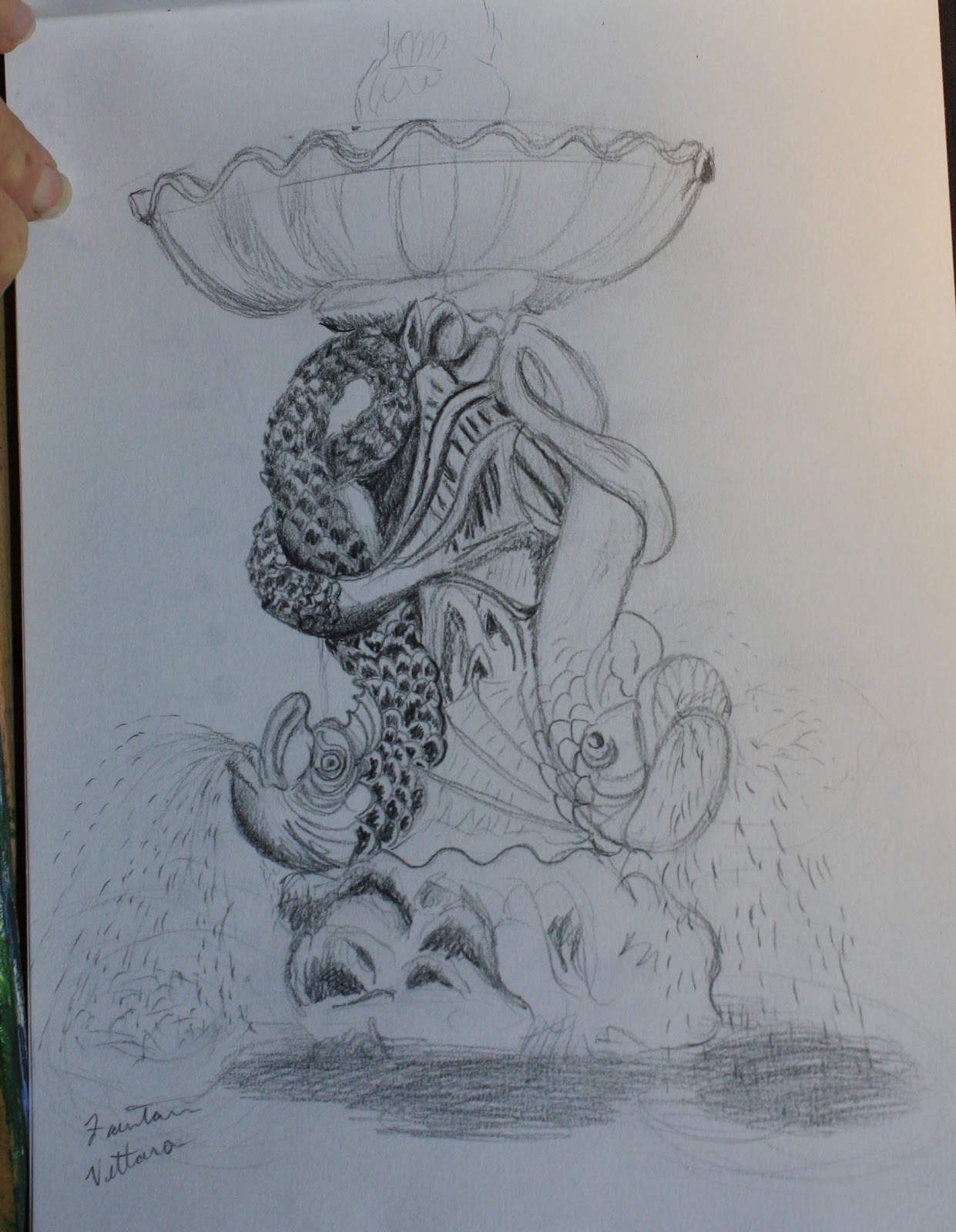
Fountain in Vittoria, pencil
Grape study, watercolor
   
Ivy takes a nap at the beach, pencil
Archway, Montifortino, watercolor


Force, pen & ink
rustico at dawn, watercolor
The beach at San Georgio, pencil


San Taddeo, watercolor


Field of Sunflowers


View of Montifortino from Mt. Sibillini


Wine Jugs, the big one is about 35 litres or more


water study, 16x20 handmade paper watercolor
San Taddeo, 16x20, handmade paper, watercolor


These last two, San Taddeo and the water study are done on luscious handmade paper that I bought at the paper making museum, made right there. They have a rough surface and a lot of sizing so they barely buckled when I did the big sky washes. I don't usually go for rough paper, but this was great for the stone texture. I bought about 20 large and 20 small sheets, along with some sheets that are colored but not as thick. I haven't tried them all out yet. 

Wednesday, September 7, 2011

Montifortino & Italian Scorpions

Italian Scorpion, about 3 inches long
I did not realize before this trip that Italy had scorpions and they are bigger and uglier than the ones we have here at home, I killed this one after I took his picture. Fortunately no one was stung.

On Tuesday morning we headed over to Montifortino, a hill town right on the edge of the Sibillini National Park. The Sibillini's are part of the Appenines, or Italian Alps. I am told that deep in the park is a glacier and that the glacier melt is what is piped to the houses and also sold as bottled water.


Town gate, Montifortino


church window, Montifortino


We parked below the town gate and hiked up to the top of the town. There was an empty church with this unusual brick treatment.

church door, Montifortino
Farther along there was another church, this one seemed to be in the process of restoration. Here you can see the original size of the doorway and how it was bricked in and made smaller.  This is very common in doors and windows in buildings all over.  There was a pretty park like area around this church and we were going to sit and draw. However, a quick black snake darted along and that made Elise quite nervous so we walked back down the hill into the more populated area.

buildings in Montifortino, note the recycling bins on the street


Montifortino
view from Montifortino towards Sibillini Mts.


Montifortino, laundry


If you live in town you hang your laundry out from your windows, like this.


Montifortino, base of the wall around the town


As we left Montifortino we drove around the base of the town.

Tuesday, September 6, 2011

We Find a Roman Temple

Montidinove
On Monday we just took a drive, taking this road and that. First we ended up in Montidinove, another typical hill town.

piazza, Montidinove


View from Montidinove


street, Montidinove
garden, Montidinove


Later we drove down the coast to Pesaro and had a bite to eat. We stopped for a bit along the beach for a snack and some sketching. We drove up the coast aways, then headed back inland.


We followed some signs for an archaeological park, which was closed, but I was able to take some photos through the fence.


As usual, nothing was in English, but I looked it up later online. Apparently this is still under investigation, but it is a Roman Temple site from around 1st-2nd century AD. But they don't know to what deity it was dedicated yet.

Farther up the hill is a little town, Monti Rinaldo. The place looked half deserted, especially since it was siesta time. Even accounting for that a lot of the buildings were empty and the windows boarded up or shuttered.

Monti Rinaldo

Monti Rinaldo
After leaving Monti Rinaldo we were headed home and decided to stop by a little 'rustico', a tumble down house for some sketching. The old houses stand up pretty well until the roof tiles start coming off in the winter winds. Then the roof slowly gives way. In the meantime ivy and even trees gain a little foot hold in the walls where eventually their roots push the rocks out of place and the walls start to come down. In a hundred years or so there may not be too much left to even show there was a house here.

We made one last stop at a little vineyard near the Retreat for some pictures of the ripening grapes.


Monday, September 5, 2011

New Print Products at Zazzle!

Roman Arch wrappedcanvas
Roman Arch by maryhysong


 I am happy to announce that Zazzle has added a lot of new print options! They now have wrapped canvas, framed prints and many other new items. I'll be adding some of my art and photography to these new items so that you can have them for your very own.


Thursday, September 1, 2011

A Festa in Force

Fire juggler, Force
On Sunday evening we went over to Force to the 'festa'. Basically a harvest festival, every town seems to have one sometime in August or September, celebrating their local specialty.

Force is well known for their traditional copper beaters. There are only a couple of little old men still making copper pots, stills (yes it's legal to distal your own alcohol here), and other items. There were little food booths set up all over the town, a few people selling jewelry.

One of the churches had an amazing model of the town and of the old crafts practiced here set up in their basement.

There was also some entertainment, singers, dancers, live folk bands, this fellow that juggled fire and did a mime act and one on impossibly tall stilts who danced. That was an amazing feat to dance on stilts on steep cobblestone streets!


More Sight Seeing in Ascoli

door to Ave Maria
We also went in the church of Ave Maria. There are some fantastic huge marble columns and sculptures from the 17th c. but the interesting part were the very early fresco fragments from the 12/13th c.

Fresco fragment, Ave Maria


We then walked down towards the Roman bridge, still in use and with cars going over it. On the way a church was open that is normally closed. San Maria dell Intervenous, the sign says it is called that because it was built over a vineyard. John however is of the opinion that it means 'of the blood'. This is because the site is right by the river and vineyards are never planted by the river, but higher up on the hills.

Either way the church is quite a find. The inside is obviously old, around 11th century and with some fairly well preserved fragments of frescoes on the pillars along with Byzantine styled lions on the portico.

San Maria Intervenous
S.Maria Intervenous fresco

S.Maria Intervenous fresco

S.Maria Intervenous fresco

ancient graffiti on the fresco


Church tower of S. Maria Intervenous


Later we walked across the Roman bridge and took a look at a place that Gabrielli had painted of which I had bought a print. I haven't taken a pic of the print, but will do that and show you the painting and a photo of the place side by side.

Ascoli

Buildings are built right over streets, Ascoli
On Sunday John took us to Ascoli to see the Gabrielli exhibit. He was a19th century painter of the Le Marche area and many of the scenes he painted can be seen today, little changed except for the addition of cars and electric lines.

It kind of cracks me up how the buildings are built right over the streets. You have to remember that this area, like most of Europe has been inhabited since prehistoric times. Most towns have Roman foundations and each generation has built on top of the last. In one street you are likely to see buildings or parts of buildings put up or remodeled in nearly every century. Everywhere you can see traces of Gothic archetecture, some still there, some bricked up.


Gothic window, Ascoli


Modern Italian building consists of pre-cast concrete wall slabs with a little brick work on the corners and around doors and windows. I much prefer the older methods of building with stone.

 
Carlos Crivelli Alter Piece


While waiting for the Gabrielli exhibit to open we took a walk. In the church of San Emideo is an original Carlos Crivelli alter piece. Fully gilded, egg tempera over gessoed wood panels, it is a beautiful piece.


altar piece closeup
San Emidio was built over a 12-13th century chapel, possibly built by Templars.
13th c. chapel under San Emidio

The crypt under San Emidio

Part of the crypt

Column capital 13th c or earlier
The earlier chapel was partly remodeled and some flashy polished marble columns were put in to replace the older ones. However, most of the capitals were kept and the carving is very fine compared to the later ones.

The early chapel was actually built over the remains of a Roman temple dedicated to Jupiter.